
Tiny Houses in Switzerland: Trend or Future?
Less space, more life. Why small houses are not a passing fad.
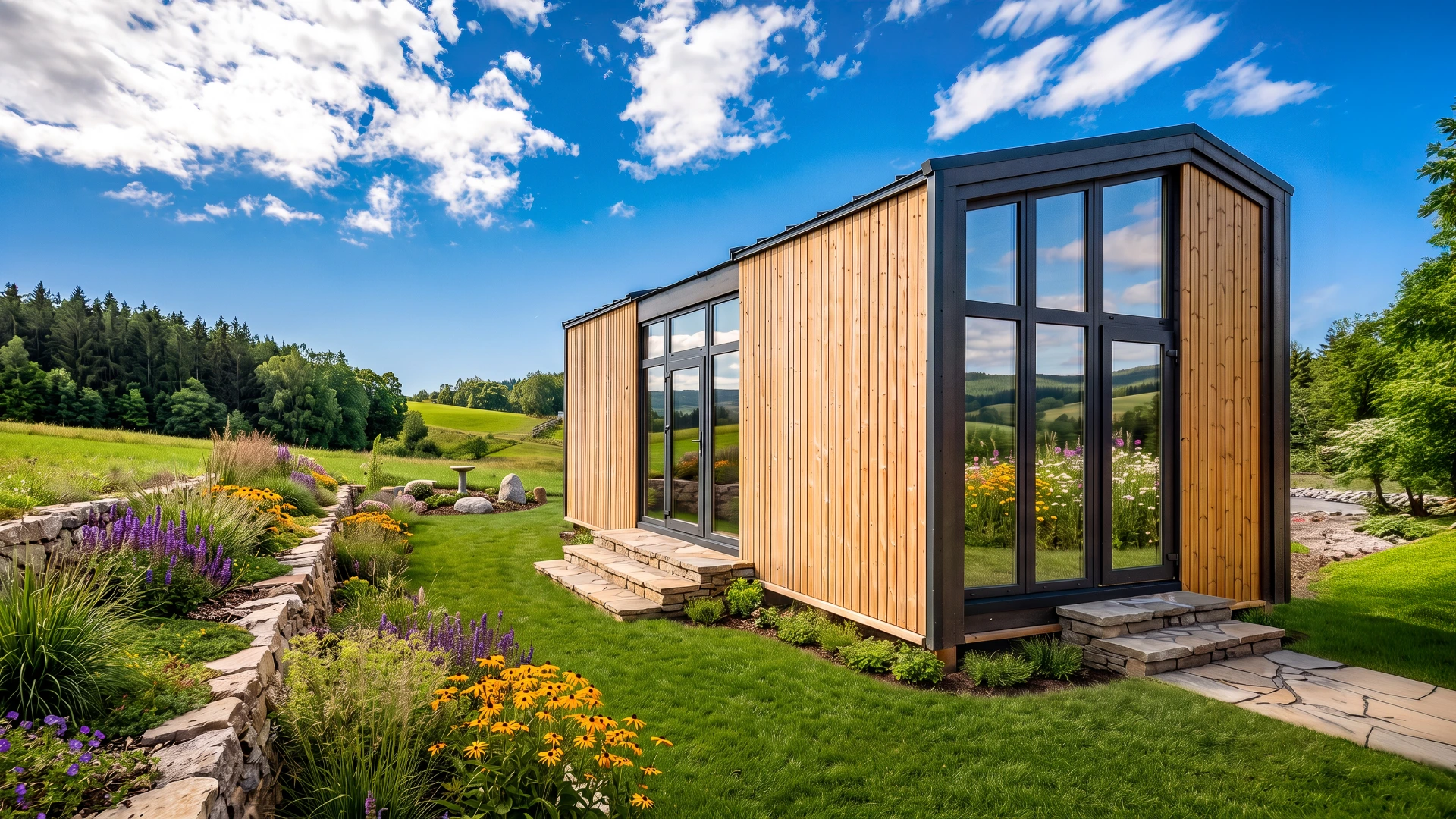
Few forms of housing divide opinion as sharply as the tiny house. For some, it is a short-lived social media hype. For others, it is a serious answer to the big questions facing the Swiss housing market: scarce land, rising prices and the desire for a more sustainable way of life.
A thesis for the Swiss federal diploma in real estate management examined whether this trend will also take hold in Switzerland. The conclusion is clear: the tiny house is here to stay. Not as a replacement for conventional housing, but as a meaningful addition. Because it offers solutions to questions that concern the Swiss property market today and in the future.
Why people want to live smaller
The reasons are well known and compelling. First comes the desire for minimalism: owning less, tidying less, managing less. This is followed by affordable home ownership and sustainability.
Living on 10 to 50 m² means making conscious choices. What do I really need? What makes my life richer? The answer is often surprisingly simple. Less space means less consumption, lower costs and more time for what matters. Living smaller does not mean going without. It means gaining freedom.
What the figures show
In Switzerland, each person occupies an average of around 47 m² of living space. In a tiny house it is considerably less, without any loss of quality of life.
A US study shows that people who move into a tiny house reduce their ecological footprint by an average of 45%.
Where tiny houses play to their strengths
- Using leftover land: Especially in rural areas, there are plots lying unused that are too small for a conventional house. A tiny house turns them into living space, where the infrastructure already exists.
- Affordable housing: Less space means lower construction and maintenance costs. For many, home ownership becomes attainable again.
- Interim use: Vacant sites often wait for years for their final development. Tiny houses bring them to life in the meantime and create temporary housing.
- The new "Stöckli": In the past, parents moved into the "Stöckli", the traditional Swiss retirement cottage, when the younger generation took over the farm. The tiny house translates this idea into the present: age-appropriate, close to children and grandchildren, but in a home of one’s own. The big house remains free for the young family.
- Modular and reusable: If a site is only needed temporarily, the house simply moves on afterwards. Modules can be transported, recombined and set up again in another location.
- Home office: Those who no longer commute every day are more likely to move to the countryside. That is exactly where tiny houses find space and peace.
The hurdle: building law
As convincing as the idea is, in Switzerland building law decides. A stationary tiny house requires a building permit. It must meet the same regulations as a normal house: zoning compliance, boundary distances, utility connections and energy standards.
Many tiny houses from abroad do not meet these requirements. That is why careful planning is essential. Only a house designed in accordance with Swiss regulations will be approved.
Our approach
This is exactly where Soldanella comes in. Our models are designed to meet Swiss building regulations. A few examples:
- Bungalow model: Our in-house development for Switzerland and its requirements. A high-quality modular building for downsizing and the modern "Stöckli": single-storey and age-appropriate, with large windows, in sizes S, M and L, with a flat or pitched roof.
- M36Loft: We have adapted this modern tiny house to a high Swiss insulation standard: U ≤ 0.15 for floor, walls and roof. Electrical and plumbing systems are planned according to Swiss standards. The result is a tiny house that meets Swiss standards and, thanks to production in Eastern Europe, remains affordable. Available only from Soldanella.
This is how a trend becomes a home that is approvable and stays that way.
Less space, more life.
Get started